Research Highlight from Aisa: 520‑Million‑Year‑Old Microfossil Pushes Back Cephalopod Origins
An international research team published in Nature reports Eoceras shaanxiense, the earliest known siphuncle‑bearing cephalopod, recovered from early‑Cambrian Shuijingtuo Formation (about 520 million‑year‑old) in southern Shaanxi, China. The finding extends the definitive fossil record of cephalopods by roughly 30 million years and narrows the long‑standing mismatch between fossil evidence and molecular‑clock estimate.
The siphuncle is the key evolutionary novelty of cephalopods such as nautiluses and squids. This internal tubular structure manages fluid and gas within shell chambers to adjust buoyancy for pelagic locomotion. Before this discovery, the oldest confirmed cephalopod was Plectronoceras from the late Cambrian (490 Ma). Molecular clock predictions suggested cephalopods diverged as early as 533 Ma, creating a major unresolved gap in their evolutionary history.
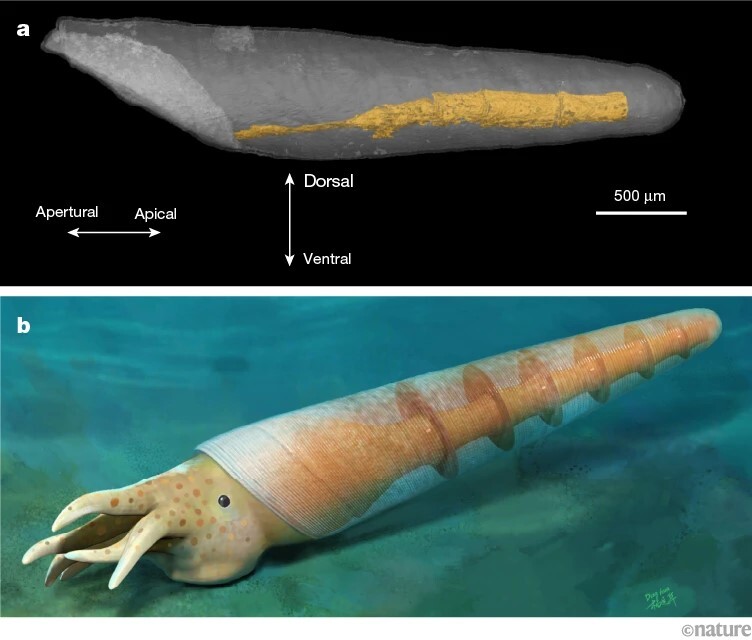
These phosphatized small shelly fossils are only millimetres long with straight, cone‑shaped shells. Using 3‑D imaging reconstruction, scientists documented internal chambers divided by septa and a primitive segmented siphuncle running along the shell’s ventral side. Unlike younger cephalopods, Eoceras had imperforate septa and closed siphuncular segments. Fluid transfer relied on permeable septal layers and tiny canals, granting limited buoyancy control. The animal likely lived mostly on the ancient seafloor.
Eoceras is interpreted as an intermediate transitional form in cephalopod evolution. The work confirms cephalopods emerged during the Cambrian Explosion. Researchers note further well‑preserved fossils, especially those retaining soft‑tissue traces, are required to clarify morphological links between early cephalopods and contemporary hyoliths and refine the early cephalopod evolutionary tree.
————
Reference:
Song, Z., Pan, B., Guo, J. et al. Earliest siphuncle-bearing cephalopod from the early Cambrian. Nature (2026). https://doi.org/10.1038/s41586-026-10868-y
Attachment Download:
